Input controllers: your mouse, relayed by hardware.
An input controller is a small box your physical mouse plugs into. It forwards your real movements to the gaming PC as a standard USB mouse — and accepts movement instructions from a second computer. The gaming PC sees an ordinary HID mouse on a normal USB port.
Mouse plugs into the box
Your physical mouse connects to the controller — not directly to the gaming PC. Full 1000Hz polling is preserved end-to-end.
Box talks to PC #2
A second link (USB serial or Ethernet, depending on model) lets your analysis PC send movement instructions to the controller.
Gaming PC sees a mouse
To Windows, it's a standard HID mouse on a normal USB port. Input arrives as ordinary USB traffic — no drivers, no kernel modules, nothing loaded into the OS.
Compare every controller
MAKCU is the community standard; KMNET moves the link onto your LAN; Ferrum 1 is the hardened enterprise unit.
| Controller | Architecture | Link | Ports | Price | |
|---|---|---|---|---|---|
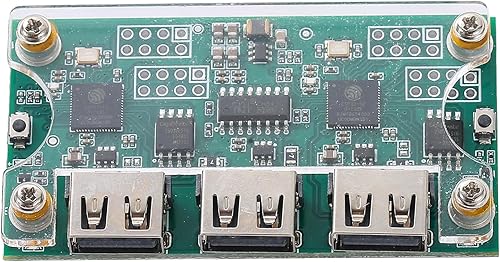 MAKCU Dual-ESP32-S3 Input Controller Flagship Hardware Bridge | Dual ESP32-S3 (Twin Microcontrollers on Green Baseboard PCB) | CH343 High-Speed Controller (4 Mbps) | — | $29.99$35.00 | View |
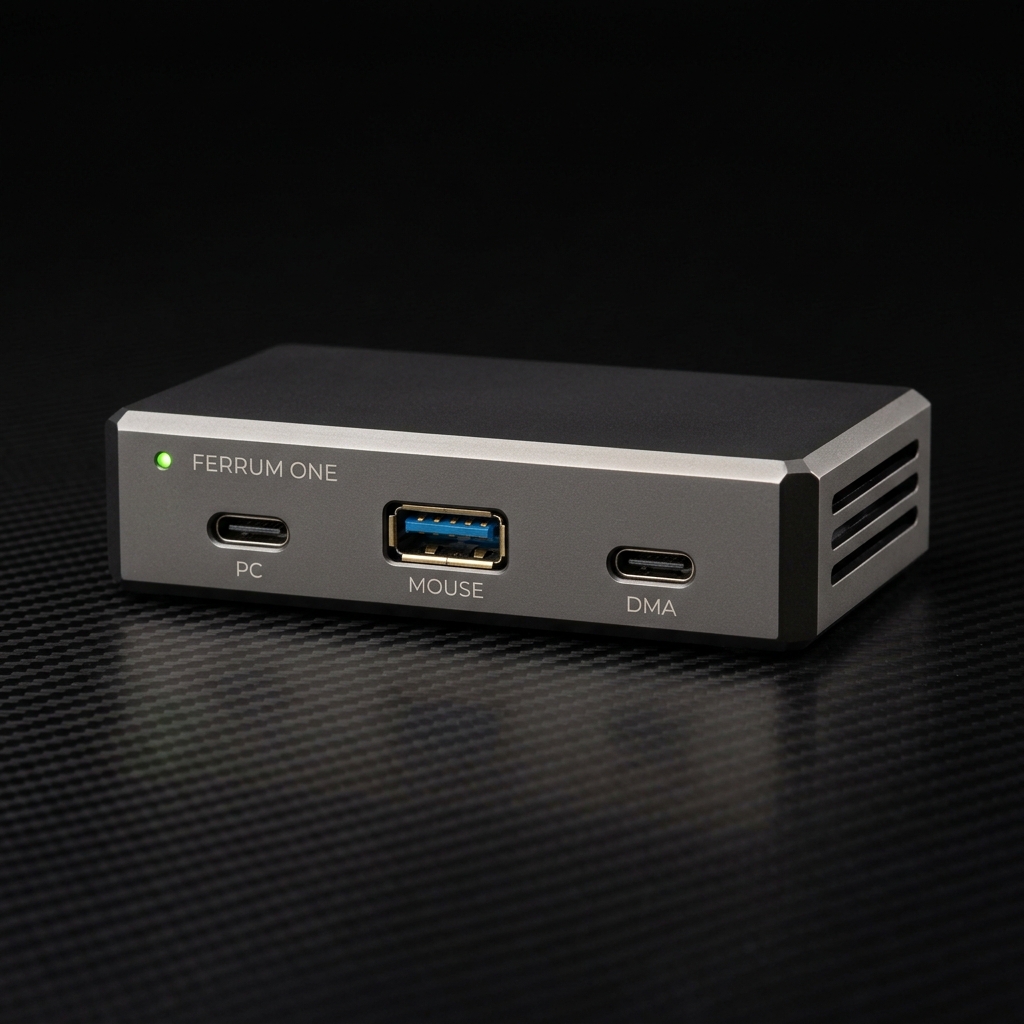 Ferrum One 8K Polling DMA Device 8K Polling Ultimate | — | USB HID | — | $169.99$199.99 | View |
KMNET Gigabit Network Input Controller Specialist Hardware KMNET Gigabit Network Input Controller Network Dual PC | 1000Mbps Gigabit RJ45 LAN | UDP Socket Communication | USB Powered 5V / 1A | $39.99$55.00 | View |
Most setups: MAKCU ($29.99)
Dual ESP32-S3 chips, open-source firmware, KmBox-compatible protocol. The default choice for 2PC builds — and the one every guide covers.
No COM cables? KMNET.
Communicates over gigabit Ethernet instead of USB serial — cleaner cable runs across the room and microsecond LAN latency.
Maximum durability: Ferrum 1.
Industrial-grade signal conditioning and RF shielding for scrims and long sessions where a dropped packet is unacceptable.
Controller questions, answered straight
Will my mouse feel different?
No. Native 1000Hz passthrough with the CH343 4 Mbps UART means your in-game feel is identical to plugging in directly.
What's in the box?
The pre-flashed controller, shielded USB cables, and the Quick-Start support card with wiring diagrams and Discord activation instructions.
MAKCU vs KmBox — why MAKCU?
Same protocol compatibility, open-source firmware you can inspect, at roughly a third of the price. We QC the capacitors on every unit before it ships.
Do I need the 2PC setup?
It's what we recommend and support fully — single-PC use is possible but not our preferred configuration. The How It Works guide explains the full topology.